
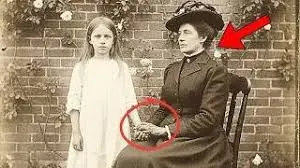
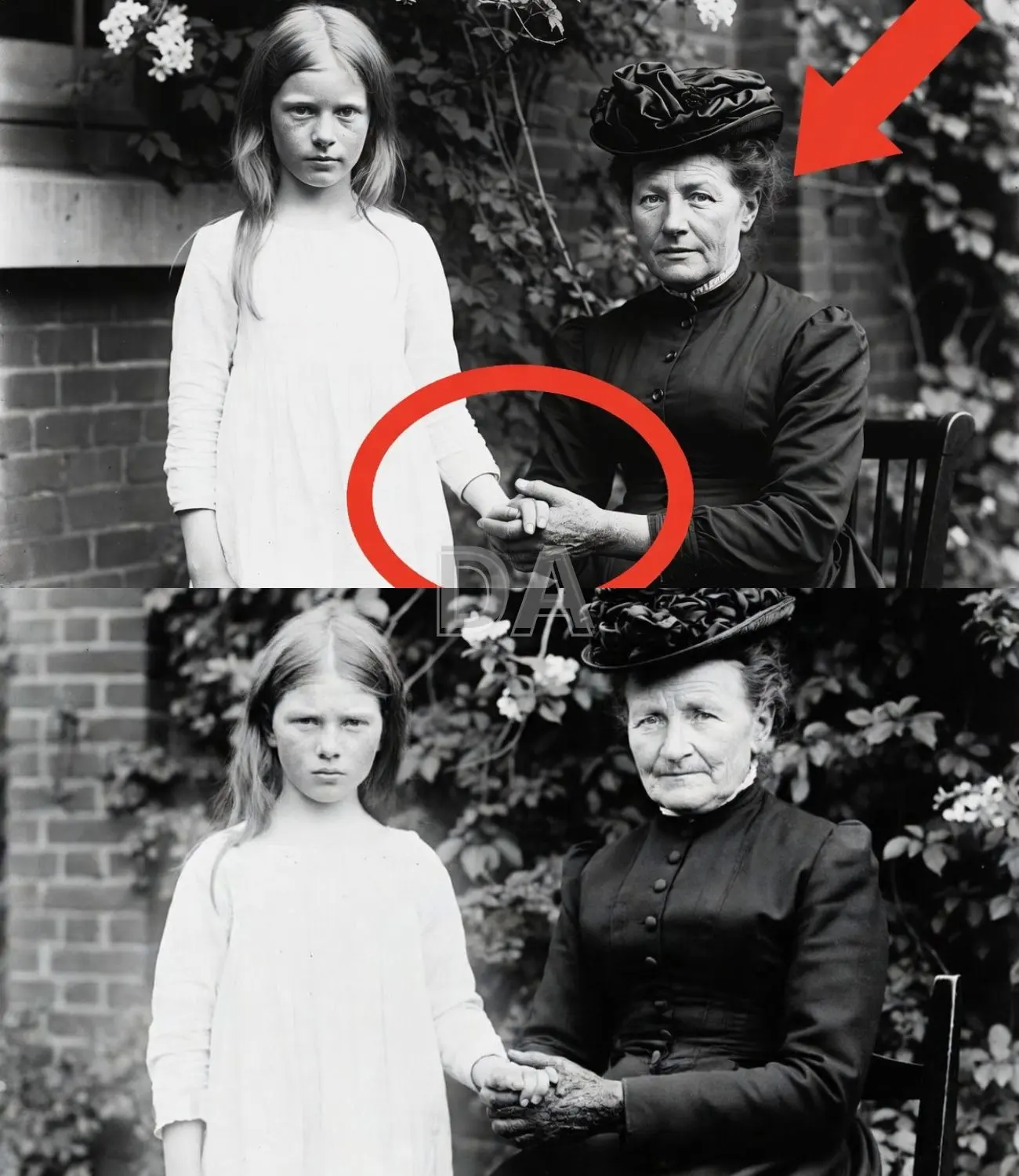
When digital restoration specialist Dr. Sarah Chen enlarged this 1899 photograph by 4,000% in 2019, she was amazed. For 120 years, anyone who looked at the image had seen a woman and a girl holding hands in a garden. A mother and daughter, perhaps a moving portrait of the Victorian era. But the high-resolution digitization process revealed something that prompted Sarah to immediately contact the police archives.
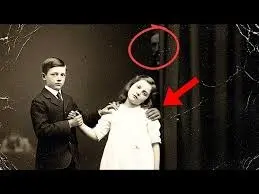
The woman in this photograph had died three weeks before it was taken. What you see is not a family portrait, but evidence of one of Victorian England’s most horrific crimes. The girl holding that hand knew nothing.
The neighbors were the first to notice the smell. It was August 15, 1899, in the Whitechapel neighborhood of London, an area sadly known for Jack the Ripper’s crimes that had occurred 11 years earlier. The summer heat was suffocating, turning the cramped buildings into suffocating boxes of bricks and misery.
But the smell coming from the ground floor apartment at 47 Thrall Street was different from the usual stench of poverty and overcrowding. It was a sweet and sour smell, like that of fruit left in the sun too long, but beneath that sweetness was something much worse: the unmistakable smell of rotting flesh.
Mrs Eleanor Blackwood, who lived in the flat above, went to the police on the morning of 15 August. He told Officer William Morris: “It’s been three weeks, three weeks with this horrible smell, and I haven’t seen Miss Hartley come out once. As for little Emma, I hear her talking inside, but she doesn’t come out either.”
Something was wrong. Officer Morris, accompanied by Sergeant James Peyton, arrived at 47 Thrall Street at 10:00 in the morning. They knocked, but there was no answer. They knocked again, harder. “Police, open the door!” They heard movement inside: light footsteps, then the high-pitched, hesitant voice of a child.
“Mom said we can’t open the door. Where’s your mother, darling?” Sergeant Peyton asked from behind the door, trying to keep his voice low even though the smell brought tears to his eyes. «It’s here. We hold hands.” The two agents exchanged looks. Peyton rested her shoulder against the door. The wood was old and brittle, so it snapped on the second try, and the lock came free from the frame with a creak that echoed down the narrow hallway.
What they found inside would haunt the two men for the rest of their lives. The apartment was a small, dark room with a dirty window overlooking the alley. In the center of the room sat seven-year-old Emma Hartley, wearing a dirty dress that may have once been white. Her tousled blonde hair fell into her face.
She was painfully thin, with sunken cheeks and eyes disproportionately large for her small face. She was holding hands with a woman sitting on a wooden chair next to her. The woman was wearing a dark Victorian dress with a high collar. The head was tilted slightly to one side. The eyes were open, but blurred, staring into space.
His skin was a greenish gray and was starting to peel away in patches from the fabric underneath. Flies buzzed in her face. The stench was unbearable. Emma looked at the policemen with wide eyes and said, very calmly, “Mom is very tired. She needs to rest. We were waiting for her to wake up.” Officer Morris staggered down the hallway and vomited.
Sergeant Peyton knelt in front of Emma, fighting the nausea, careful not to startle her. “My darling,” he said softly, “how long have you been resting?” Emma thought about it, her little face darkening in concentration. “Since my birthday. He said it was… I don’t know how many days. I tried to count, but I lost track. We ate cake.”
Then my mother sat down and fell asleep, and never woke up. But she told me to never let go of her hand, and so I did. I was very obedient. Three weeks. The little girl was left alone with her mother’s body for three weeks, holding her hand the entire time, thinking she was asleep. Two days before the police found Emma and her mother’s body, something very strange happened.
On August 13, 1899, a man knocked on the door of a house on 47th Street. His name was Thomas Whitmore and he was a traveling photographer specializing in portraits, a common practice in the Victorian era which consisted of photographing the deceased as a final tribute. Portrait photography was popular in the 1890s, a time of high mortality rates, especially among children, and portraits were expensive.
For many families, the only photograph they had of a loved one was taken after their death. Photographers posed the bodies as realistically as possible, sometimes placing them on chairs, opening their eyes, or placing them with family members. Thomas had received a request four days earlier, delivered to his office by a street child who said a woman had given him two cents to deliver it.
The letter was handwritten by a woman on cheap paper. Mr. Whitmore, I would like you to take my picture. I am very sick and I don’t think I will get better. I would like one last photo with my daughter Emma before I die. Please come to 47th Street, Whitechapel on August 13th at 2pm.
The two pounds will be left under the carpet. Please knock twice and come in. We will wait for you in the garden behind the building. Miss A. Hartley. Thomas found the request strange, but not unprecedented. The two pounds was a generous sum, more than he was used to. He assumed that Miss Hartley was bedridden and wished to be photographed while she was still able to appear, before her presence became too disturbing due to death.
He arrived at the address at 2pm, bringing his photography equipment with him. The building was dilapidated and the neighborhood was dangerous. Thomas was worried, but the sum was reasonable. He found the two pounds under the doormat, just as promised: two gold coins glittering in the midday sun. He knocked twice. Nobody answered. Following the letter’s instructions, he tried to open the door.
The door was open. He pushed her. “Good morning, Miss Hartley.” A nauseating odor immediately filled the air. That sweet smell of decay. But Thomas had been working with the dead for 15 years. He had smelled that smell before. He assumed that Miss Hartley was already dead and that a member of staff or a family member had probably wanted to take a quick photograph before the burial.
“Hi,” he called again. He heard a faint voice coming from outside. «We are in the garden. Mother said you would come.” Thomas walked through the apartment, breathing through his mouth, and out the back door into a small, bushy garden, enclosed by a high brick wall. There, in a ray of afternoon sun, a little girl dressed in white held the hand of a woman sitting in a chair.
The woman was standing on her side, her face turned slightly towards the garden, away from the camera. She was wearing a dark dress and a wide-brimmed hat that cast a shadow on her face. His free hand rested in his lap. He was perfectly still. The little girl smiled at Thomas. “Mom is ready for the photo,” Emma said excitedly.
“This is very important,” he said. “You have to resume exactly as we are now, hand in hand.” “I must never let her go,” he said. Thomas Whitmore positioned his camera. The scene was truly magical: the afternoon light, the lush roses climbing the wall behind them, and the tender image of mother and daughter, hand in hand.
The stillness of the woman and her face in the shadow were perfect for the long exposure time required. He never wondered why he didn’t move or speak. He assumed she was already dead, carefully positioned like that. After all, that’s what he was doing. It was what he was paid to do. He was the one who took the photo.
He gathered his equipment and left, unaware of the horror of what he had just documented. When Sergeant Peyton gently removed Emma from her mother’s body on August 15, the little girl screamed. It was a sound Peyton would hear in her nightmares for decades. Not a scream of fear, but a scream of pain and betrayal.
Emma struggled with unexpected strength for a malnourished child, desperately trying to reach her mother’s hand. “No, no, Mommy said never to leave her. She made me promise. I have to hold her hand or she won’t wake up. Let me go, Mommy.” The two police officers had to force Emma out of the apartment because the little girl resisted and was crying.
Blackwood, who lived upstairs, took the little girl to his apartment, washed her and tried to feed her soup, but Emma refused. He stared at the floor and whispered, “I left her alone. I shouldn’t have left her alone.” Downstairs, the police began their investigation. Dr. Harold Graves, the medical examiner, arrived to examine the body. His first assessment was that Miss Adelaide Hartley, aged 31, had been dead for about three weeks, which matched Emma’s account: “Since my birthday, July 25th.”
The cause of death appears to have been morphine intoxication. An empty brown bottle labeled “Idenum” was found on the floor next to the chair, along with a teacup that still contained dried residue. Idenum, an opioid tincture, was commonly used to relieve pain and treat insomnia. In sufficient quantities, it could cause respiratory failure.
But what they discovered later transformed that tragic death into something far more disturbing. In the woman’s lap, under her crossed hand, there was a letter. The paper was slightly stained, but the ink was still legible. Sergeant Peyton opened it carefully and read: “To anyone who finds this letter, my name is Adelaide Hartley.”
I am dying of tuberculosis and the pain has become unbearable. I took Idamin to end my suffering. I know it’s wrong, but I can’t take it anymore. My daughter Emma is seven years old and no longer has a family. I organized one last photo together. The photographer will come on August 13th.
Emma thinks I’m sleeping. I told her to hold my hand and not let go until someone comes. I know that sooner or later someone will come. Please tell Emma I’m sorry. Please tell her I love her. Please tell her it wasn’t her fault I didn’t wake up. Take care of my daughter. She deserves more than I can give her.
[Clears throat] Omaha, July 25, 1899. Peyton’s hands shook as she finished reading. The implications were shocking and horrific. Adelaide Hartley had committed suicide by poisoning herself at the hands of an Indian, but she had planned everything with disturbing precision and care. He had corresponded with the photographer previously. He had agreed on the payment.