
The official version has always been simple, almost convenient: humanity reached the Moon, planted its flag, collected samples and returned home. Afterwards, interest waned. Budgets have been cut, politics have changed and lunar exploration has been dismissed as a glorious but closed chapter. For decades, this explanation sufficed. Nobody asked too many questions. No one insisted on what was missing.
Until now.
Because the emerging version of events isn’t about money or geopolitical priorities. Talk about silence. Of orders. Of something that, according to one of the protagonists, should never have been seen.
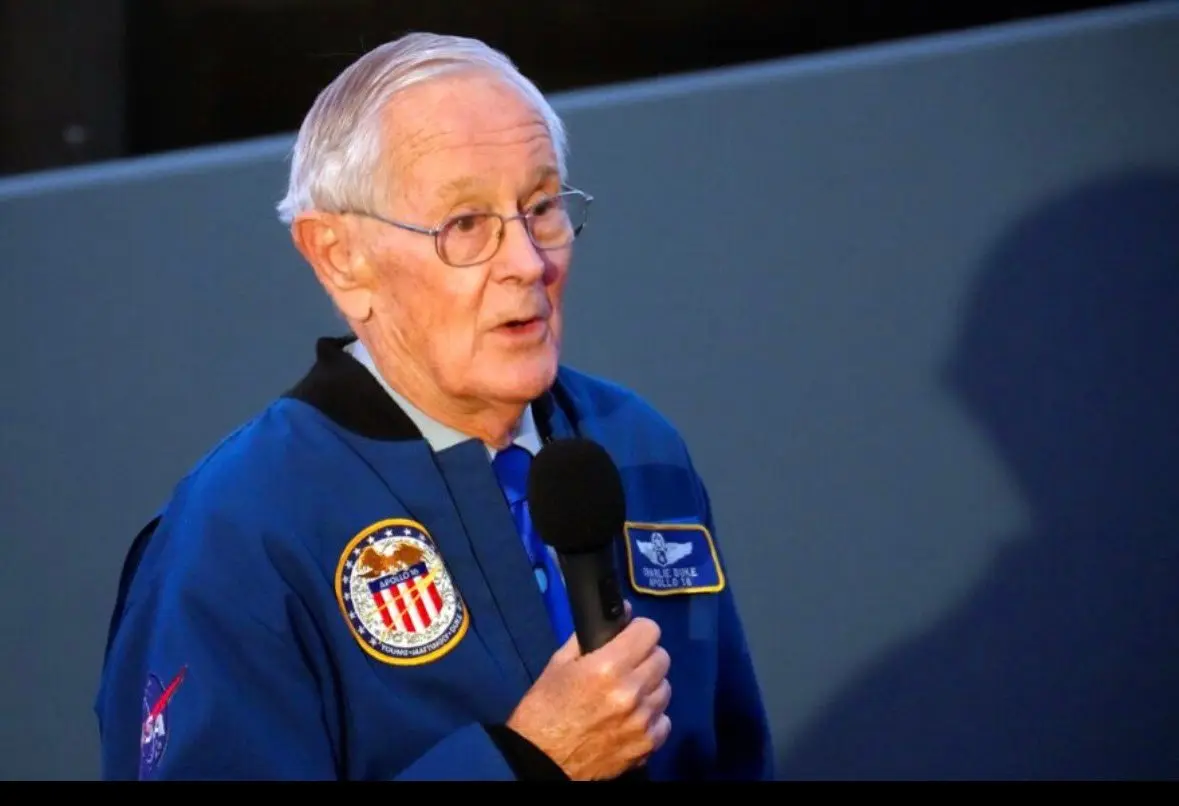
The man at the center of this revelation is not a conspiracy theorist or a fringe voice on the internet. This is Charles Duke, the tenth human being to walk on the lunar surface. A brigadier general in the US Air Force. A pilot, an engineer and a first-hand witness to one of the most ambitious missions in human history. For decades, its credibility was beyond question. Until he decided to speak.
April 1972. The Apollo 16 mission landed in the Descartes Highlands, a lunar region chosen for its geological interest. Duke and his commander, John Young, had received precise instructions: collect samples, conduct experiments, document the terrain. All within a strictly calculated timescale. Nothing out of plan.
But what they found didn’t fit into any manual.
According to the story that Duke began to share with an ever-widening circle of people, there was a moment – brief but decisive – when both astronauts observed something that shouldn’t have been there. It wasn’t a rock. It was not a recognizable natural formation. It was something different. Something that defied the expectations of a surface that, until then, had been considered inert and predictable.
Duke described the discovery in Houston with the technical precision typical of NASA astronauts. Every word was thoughtful. Every detail was carefully conveyed. What followed, he says, was what truly marked him.
Silence.
Not the usual delay in communications. Not occasional interference. A prolonged, heavy, almost deliberate silence. A void that lasted longer than expected, long enough for Duke and Young to exchange glances inside their helmets, aware that something wasn’t working as usual.
When the answer finally came from Earth, it wasn’t a question. There was no scientific curiosity. There was no request for further data.
It was an order.
“Continue mission. Do not investigate further.”
It’s that simple.
It’s so cold.
For years, that moment remained buried under layers of technical reports, classified recordings, and carefully edited memoirs. Duke, like the rest of his colleagues, knew the unwritten rules. There were things that weren’t talked about. Things that were not shared. Space exploration, at the height of the Cold War, was not just about science. It was about power, about storytelling, about control.
And he obeyed.
Forty years of silence.
Forty years spent protecting a version of history that left out the essentials.
But time changes men. And it changes their priorities. At 89, Duke no longer responds to hierarchies or protocols. He has nothing left to lose. And, according to those who have had access to his most recent statements, he has no intention of remaining silent.
What is disturbing is not only what he claims to have seen, but also the explanation he is offering now.
Because, according to Duke, that discovery was not ignored for lack of interest, but was deliberately avoided. The order to “move forward” was not about maintaining the pace of the mission, but rather about distracting the astronauts from something that was apparently already known to those on Earth.
This raises an uncomfortable question: If Houston showed no surprise, does that mean they already knew what was there?
The traditional narrative of lunar exploration has always been based on the idea of the unknown. Each mission is like a step into the unexplored. But if what Duke suggests is true, then at least some of that “unknown” had already been anticipated. Identified. Maybe even studied.
And then another, even more disturbing question arises: Was this the real reason we never returned?
After the Apollo 17 mission, in December 1972, the manned lunar program came to an abrupt end. There was no immediate continuation. No permanent bases were built. No new missions were launched with the same ambition. The Moon, which had been the central goal of a global race, was relegated to a memory.
Officially, the explanation was economic in nature. The cost was too high. Public interest was waning. Priorities were shifting toward space stations and unmanned missions.
But Duke’s testimony introduces a crack in this version.
Because if what they found in Descartes’ highlands represented a risk, or something that simply couldn’t be explained publicly, then the decision not to return there may have been less about money and more about control of information.
Duke does not describe the object exhaustively. It does not offer photographs. It presents no tangible evidence. And this, of course, fuels skepticism. However, his tale is not constructed as a sensational story intended to impress. It is presented with the sobriety of someone who has kept a secret for too long.
He doesn’t try to convince. It just tells the story.
And this, for many, is what makes the situation disturbing.
Because in the world of classified information, omissions are often more revealing than direct statements. What isn’t said, what is omitted, what is diverted… it all contributes to building an accurate narrative.
Today, as new space powers announce plans to return to the Moon – this time to stay – Duke’s words resonate with an unexpected intensity. It’s no longer just about looking to the past. It’s about understanding whether there is something in that past that continues to influence decisions in the present.
The Moon, that seemingly silent body that has been orbiting Earth for billions of years, may not be as simple as we thought.
And if a man like Charles Duke decided to break the silence after half a century, perhaps the question would no longer be why we stopped going.
But what exactly made us stop… and are we really ready to return?